Using the Skill-Creator Skill to Improve Your Existing Skills
Anthropic’s skill-creator skill recently got an update that adds evaluation capabilities — the ability to test your skill against synthetic prompts, grade the outputs, and compare old vs new versions. I ran it on my writing-voice skill to see how it works.
What the Skill-Creator Does Now
The skill-creator is a meta-skill for creating and improving other skills. It could already help you write new skills and edit existing ones. The update adds evaluation capabilities — so now it can also:
- Analyze your existing skill against real examples (blog posts, code, whatever it’s supposed to produce)
- Generate test cases with assertions
- Run those tests against both the old and new versions of the skill in parallel
- Grade the outputs and show you a comparison in a browser-based viewer
- Optionally optimize the skill’s description so the agent triggers it more reliably
The commit adds a bunch of supporting infrastructure — subagent prompts for analysis, comparison, and grading, Python scripts for running evals and generating reports, and an HTML viewer for reviewing results.
Trying It on My Writing-Voice Skill
I have a writing-voice skill — a markdown file that tells the agent how to write in my voice. Other skills can call it when they need to match my tone. It triggers on phrases like “use my voice” or “write in my style.”
The v1.0.0 skill covered voice, structure, tone, formatting, and what to avoid, all extracted from my actual published writing. It worked, but I wanted to see if the skill-creator could find gaps.
Studying My Posts
The agent fetched 5 of my blog posts and analyzed patterns the existing skill didn’t capture. It found quite a few:
- Problem-solution arc — nearly every post follows: problem, what I built, how it works, the result. The old skill mentioned this loosely but wasn’t specific.
- Opener patterns — I use distinct opener types: problem/situation, question from a reader, observation, reference to prior work. Not documented.
- Closing patterns — I often just stop after the last point. Sometimes a practical final line. Never a summary paragraph.
- “The short answer: X” pattern — a quick summary right after the opener.
- Contrast/reframing — “The question isn’t really A vs B. It’s C.”
- Sentence fragments for emphasis — “Fair enough.” “That’s it.”
- Matter-of-fact vs combative — the old skill said “opinionated” but my actual voice is more matter-of-fact. I state what works for me without attacking alternatives.
- Short paragraphs — rarely more than 3-4 sentences. Often 1-2.
The agent wrote a v2.0.0 incorporating all of this.
Running Evals
The skill-creator generated 3 test prompts designed to exercise different aspects of the voice:
- A Render-to-Hetzner migration post — tests cost comparisons, acknowledging alternatives, specific numbers
- A Bun OG image script post — tests the short “here’s a script I wrote” format, problem-solution arc
- A Drizzle vs Prisma comparison post — tests fair-comparison tone, reframing pattern
For each prompt, two subagents ran in parallel — one with the old skill, one with the new. That’s 6 runs total. Each output was graded against assertions like “uses first person throughout,” “no inflating adverbs,” “short paragraphs,” “acknowledges alternatives fairly.”
Results
| Test Case | New Skill | Old Skill |
|---|---|---|
| Render to Hetzner | 10/10 (100%) | 9/10 (90%) |
| Bun OG Script | 9/9 (100%) | 9/9 (100%) |
| Drizzle vs Prisma | 9/10 (90%) | 9/10 (90%) |
The quantitative scores were close. That makes sense for a writing voice skill — the real differences are qualitative. Reading both outputs side by side, the new skill produced writing that felt closer to how I actually write. The old skill’s output was fine but missed some of the patterns — no reframing, longer paragraphs, more generic closings.
The Eval Viewer
The skill-creator generated a static HTML viewer that opened in the browser with two tabs — one for reading the full outputs and leaving feedback, one for the benchmark numbers. You click through each output one at a time — old skill for test case 1, new skill for test case 1, old skill for test case 2, and so on. Not truly side by side, but easy enough to compare when you’ve just read the previous version. And if it bothers you enough — well, you do have a coding agent right there.
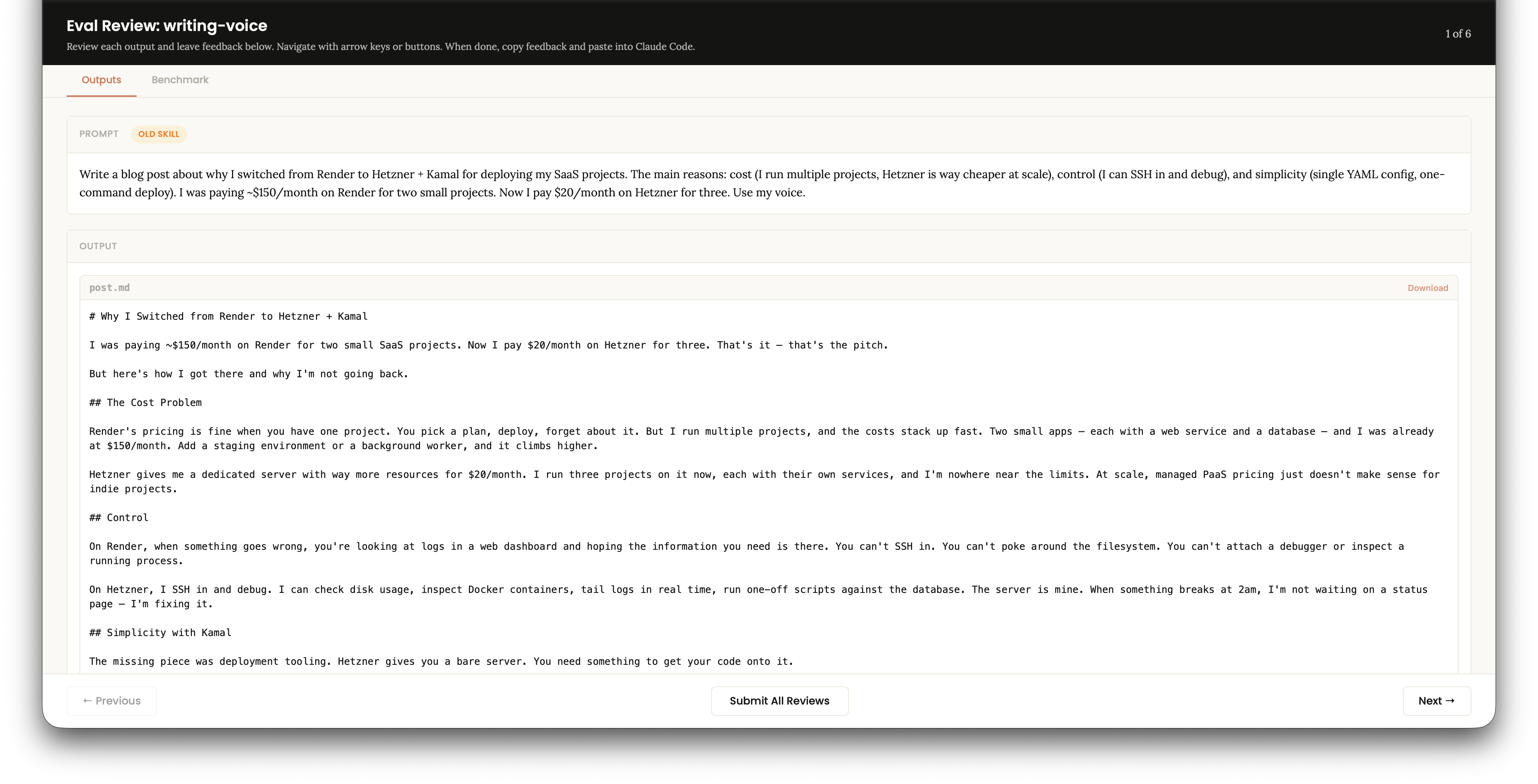
I clicked through all 6, submitted my review — which downloads a feedback.json that the agent reads back.
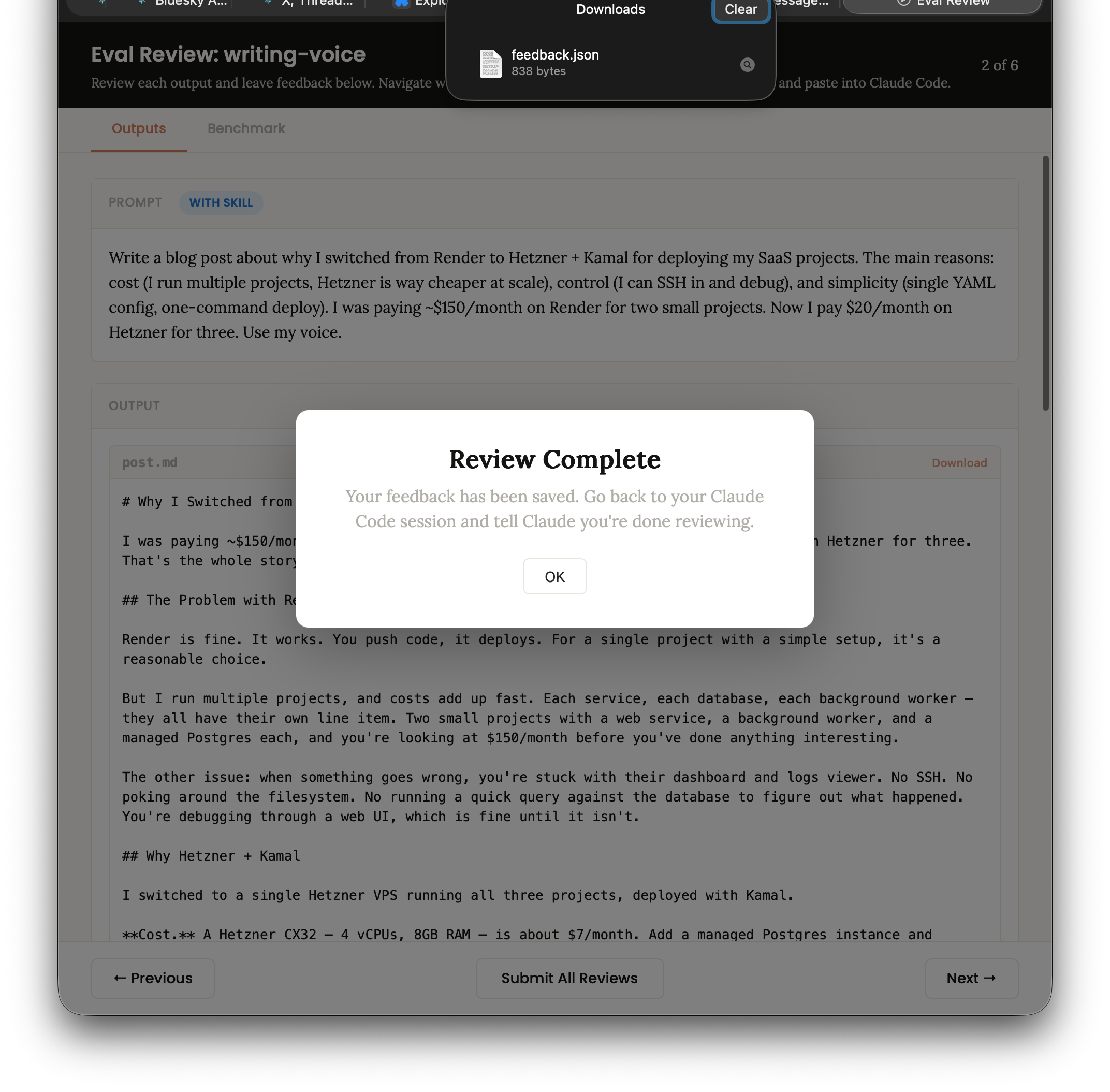
Both versions were fine, but the improved one was noticeably better on the subtleties.
Was It Worth It?
The whole process took one session. The agent did the heavy lifting — reading my posts, identifying gaps, writing the improved skill, generating tests, running them, and producing the comparison viewer. I just reviewed the outputs and confirmed.
For a style skill like writing-voice, the evaluation framework is probably overkill — you can tell by reading two paragraphs whether the voice is right. But for more complex skills with specific behavioral requirements, being able to run assertions against outputs and compare versions systematically is useful. The skill-creator now gives you that without having to build your own eval harness.
I need to try this out more. The eval process is designed to loop — improve, test, review, improve again — so you can keep tightening a skill over multiple iterations. I can see this being genuinely useful for people who build and share skills, or even sell them. Whether most people will actually take the time to run evals diligently is another question. But the infrastructure is there now, and it’s good.